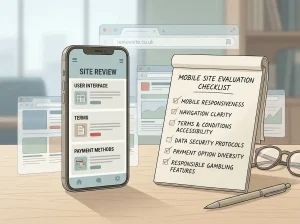
Cluster pays slots use matching symbol groups rather than defined lines, while game rules and promotion terms shape how play works.
How Cluster Pays Wins Differ from Payline Wins
A payline win is organised around a pattern of symbol positions. The game’s rules define one or more lines across the reels, and a qualifying combination must land on a permitted line in the required arrangement. The line is the reference point: symbols elsewhere on the screen do not form that particular line win.
Cluster pays use a different organising idea. Instead of asking whether symbols occupy positions along a defined line, the format looks for a qualifying group of matching symbols. That shifts attention from a route across the reels to a group within the play area. The exact group rules depend on the individual game, so the phrase “cluster pays” alone does not establish which symbols qualify, how a group is identified or what it pays.
That is the useful distinction in cluster pays versus paylines: one format is described through symbol positions on lines, the other through groups. It is not a statement that one format pays more often, pays larger amounts or is easier to understand in practice. Those outcomes depend on rules and values that cannot be inferred from the format label.
What the format label can tell you
The label gives a broad clue about how a win is organised, not a complete calculation. A payline-based game needs rules defining its lines and the combinations that count on them. A cluster-based game needs rules defining what counts as a group and when that group produces a win. In either case, the game’s own paytable and instructions supply the operative details.
This matters because familiar words can create false certainty. “Group” does not, by itself, say whether symbols must touch, how many are needed, whether position matters, or how the game treats more than one qualifying group. Those details are not interchangeable between games. Treating every cluster pays slot as if it followed one universal formula would be like assuming every payline game uses the same lines and awards.
Cascading Slot Games UK: Features, Bonuses and Terms
The same caution applies to the phrase “cluster pays slot wins”. It describes a category of outcome, not a fixed amount or a guaranteed return. A qualifying pattern may be identified by the game’s rules, but the format name does not reveal the value assigned to it. The payout calculation has to be read in the context of that specific game.
Why the comparison is not a payout forecast
A visual group can look more prominent than a line, but appearance is not a measure of value. On a payline screen, a line may make the qualifying positions easy to trace; on a cluster screen, a connected group may be easier to spot. Neither visual arrangement establishes how much the result is worth. The rules determine whether a pattern qualifies, and the paytable determines its stated value.
Nor does the distinction establish how often wins occur. That would require information about the particular game and its operation, not merely the terms “cluster” or “payline”. Comparing the formats on the basis of a single displayed result confuses the shape of a win with its frequency and payout.
For anyone trying to understand cluster pays explained in plain terms, the short version is this: payline wins are defined by specified lines of positions; cluster wins are defined by qualifying groups of symbols. The comparison stops there until the individual rules are known. A game’s title or format label is not a substitute for its paytable.
The practical reading order is therefore straightforward: identify what the game calls a qualifying line or group, check the conditions attached to that pattern, then look up its listed value. If those parts are not clear, the format name cannot fill the gap. It tells what kind of structure to look for, not the complete arithmetic behind the result.
Cluster Pays Slots: The Core Format
“Cluster pays” is a label for a slot format, not the name of a particular game or a complete set of rules. It can help distinguish the kind of slot being discussed, but it does not identify a title, its operator or the conditions attached to play. Those details have to be checked separately. A category name is useful for sorting games; it is not a substitute for the game’s own rules.
Two games described as cluster pays slots may have completely different layouts, symbols, payouts, and additional features.
That distinction matters when comparing cluster pays slots online. Two games described with the same broad label cannot be assumed to have identical layouts, symbols, payouts or additional features. Nor does the label establish how a particular result is formed or valued. Those are game-specific matters, and the format name alone cannot settle them. Treating the category as if it were a complete specification would put more weight on the label than it can carry.
The same caution applies to the terms “cluster pay slot” and “cluster slot”. They are different ways of referring to the general category, not evidence that every game using the wording shares the same design. A listing may use a short category description, while the individual game has its own rule page. For a meaningful comparison, the game rules are the relevant document; the category label is only an initial indication of what kind of slot is being presented.
What the label does—and does not—tell you
The format name does not, by itself, confirm a game’s return rate, volatility, maximum payout, eligible stake range or availability at a particular casino. Those are separate characteristics. Without game-specific details, assigning them to cluster pays slots as a group would be guesswork. The same applies to assumptions about the software provider, the number of reels or rows, or the presence of bonus features: the category name cannot verify any of those points.
Bonus Buy Casinos in the UK: Slots and Offers
A casino catalogue can also change. A game being described as a cluster pays slot in one listing does not establish that it is currently offered by every UK casino, or even by a particular casino at the time of checking. Availability depends on the operator’s own catalogue. A category search or menu can narrow the field, but the individual game page and the operator’s current offering determine what is actually available.
For the same reason, there is no basis for treating “cluster pays casino slots” as a single product with one set of terms. The phrase covers a type of game, while the casino, the game and any promotion each have separate conditions. A game’s rules explain its play; the operator’s terms govern account and promotional matters. Mixing those documents can produce a misleading picture of the total conditions.
The format should also not be mistaken for a promise of a particular result. A category name describes a classification, not a forecast of how often a slot will pay or how much it may return. A clear assessment needs the individual game’s published information and the operator’s terms. Without those, comparisons based solely on the label have little financial value.
The UK setting
In Great Britain, remote operators offering gambling to consumers must hold the relevant licence from the UK Gambling Commission. Online gambling is legal for adults aged 18 and over when offered by a UKGC-licensed operator. The Gambling Act 2005 governs gambling in England, Wales and Scotland; it does not apply to Northern Ireland. These are market rules, not properties of the cluster pays format.
Regulatory Status
Online gambling in the UK is legal only through operators holding a valid UK Gambling Commission licence.
A game’s presence on a website does not, by itself, establish that the site is authorised to serve UK players. The operator’s licence status and the game’s description answer different questions. The licence concerns the operator’s permission to provide gambling in the market; the category label concerns how a game is described. Neither should be used as a substitute for checking the other.
UK online slots are also subject to stake limits per game cycle: £2 for customers aged 18 to 24 and £5 for customers aged 25 and over. The £5 limit for all adults took effect on 9 April 2025. These limits apply to online slots in Britain generally; they do not define the cluster pays category or indicate how a particular slot handles a win.
For anyone assessing a cluster pays slot in the UK, the useful starting point is therefore narrow: identify the exact game, read its rules, and separate its description from the operator’s licence and terms. The phrase “cluster pays” supplies a category, not the financial or technical detail needed to judge an individual game.
Trying a Cluster Pays Slot in Demo Mode
A demo option can be useful when the aim is to inspect a cluster pays slot before deciding whether to play for money. Its presence should be confirmed on the game or operator page: the name of a slot, or a description of its format, does not establish that a free-play version is available. Nor does the word “demo” by itself explain what the mode contains.
25 Free Spins No Deposit in the UK: How They Work
The first check is whether the specific game has a clearly identified demo setting. If it does, the screen should make the selected mode apparent before play begins. If no such option is shown, there is no basis for treating the game as playable for free. A general casino lobby may contain many slot titles, but that does not establish demo access for each one.
A demo can serve as a way to become familiar with a particular title’s presentation and controls, provided that the operator makes that mode available. The value is practical rather than financial: it allows the interface to be viewed without treating a promotional description as a substitute for seeing the game itself. No conclusion about a title’s quality or likely results follows from its availability in demo mode.
The distinction between a cluster pays slot and other slot formats is not a reason to assume that its demo works in a particular way. The game’s own display and instructions are the relevant details. A title may be described as a cluster pays game, yet that description does not confirm a demo, explain how to open one or establish what the mode includes. Those points require clear information for the individual game.
A demo mode allows a player to inspect the interface and controls of a slot without treating promotional descriptions as a substitute for seeing the game itself.
There is also a difference between finding a demo and being able to use it in a particular setting. A game page may identify a free-play option, while access through a casino account or device may present a different route. The stated availability should therefore be read as applying to the route actually shown, not as a promise that every version of the game can be opened in the same way.
For UK players, the wider legal distinction remains relevant where play involves money: online gambling is legal only through an operator holding a UK Gambling Commission licence. A demo label alone does not establish that status. It describes a mode, not the operator’s regulatory position, so the two details should not be treated as interchangeable.
The useful standard is modest. A clearly labelled demo can answer whether a particular game offers a free-play mode and let its screen be inspected. It does not establish that every cluster pays title has such a mode, and a game description is not evidence of access. Availability should be confirmed on the relevant game or operator page rather than inferred from the format name.
Cluster Pays Slot Games and Their Features
A cluster pays label identifies a broad slot format, not a complete specification of a game. It does not, by itself, tell a player which features are included, how they behave or what a particular title will display. Those details belong to the individual game information and rules.
30 Free Spins No Deposit in the UK: Offer Terms
That distinction matters when comparing cluster slot games. Two titles can share the same format label without sharing the same presentation or feature set. A catalogue description may highlight a theme or visual style, while the rules explain the functions that affect play. Treating the label as a promise of particular features would be a poor basis for comparison.
What to check in a game description
The useful starting point is the game’s own information panel or rules page. These should be read as specifications, rather than as promotional summaries. A short description can identify the broad format; the rules are where operational details should be checked before play.
The following points help separate a clear description from one that leaves important questions open:
- Feature names and conditions: Note what each named feature does and what has to happen for it to become available. A feature name alone is not an explanation.
- Symbols and display information: Check how the rules describe relevant symbols and any changes to the game screen during play. Artwork may suggest a function that the rules define differently.
- Game controls: Identify which controls affect a spin and which only change the presentation. The distinction is practical: a visual setting should not be mistaken for a change to the game’s rules.
- Rules and information access: Check whether the instructions are available from the game itself and whether they describe its features in usable terms.
This is a way to assess the information provided, not a claim that every cluster pays slot includes any particular feature. If a description does not explain a point, its presence or effect should not be inferred from the format label.
Comparing games without assuming features
For a like-for-like comparison, record the details that are actually stated for each title. Keep the game name, its format description and its listed features separate. That prevents a familiar label or a similar-looking screen from doing the work of a rules check.
Presentation can also affect how easily the rules are understood. A game may use distinctive graphics, animations or terminology, but those elements do not establish what a feature does. The written explanation remains the relevant reference. Where the game uses a term without defining it, the description has not supplied enough information to support a confident comparison.
A casino’s catalogue may group titles under a shared category, but category placement is not a substitute for each game’s rules. The same applies to summaries that describe a slot as feature-rich without setting out the conditions. For assessing cluster pays slot features, specific explanations carry more weight than broad adjectives.
Do
- Use the game’s own information panel or rules page
- Record details actually stated for each title
- Check the written explanation for feature functions
Don’t
- Treat the format label as a promise of features
- Assume a feature based on its name alone
- Rely on a casino’s category placement for rules
No list of named cluster pays casino games is useful without reliable, game-specific details to compare. A name alone would not establish its rules or features. The more defensible approach is to assess each title from its own information and avoid transferring assumptions from one slot to another.
In short, the format label narrows the type of game being considered; it does not settle what the individual game contains. A feature comparison is only as sound as the descriptions behind it. When those descriptions are precise, the differences can be recorded. When they are not, the gap should remain a gap rather than being filled with an assumption.
Bonus Rounds and Free Spins: Check the Conditions
A slot’s built-in bonus round and promotional free spins are separate things. A search for cluster pays slots with bonus rounds may concern features inside a game, but promotional spins are an offer attached to an operator’s terms. The existence of one does not confirm the other, and free-spin conditions should not be treated as a description of how a slot’s own bonus round works.
For promotional spins, the first calculation is eligibility: which slot can be played with them? A specialist review has reported that free spins may be limited to specific games selected by the operator. If the eligible game is not the intended cluster pays slot, the offer does not serve that purpose. The listed game name matters more than the promotional label.
Next comes the stake value assigned to each spin. That determines the amount placed on each spin, but it does not by itself establish what winnings can be kept or withdrawn. The terms need to state how spin winnings are treated: whether they are credited as cash or bonus funds, and whether any further conditions apply. Without that detail, the headline number of spins is not a final value.
Expiry can remove the offer before all spins are used. A specialist review has described free-spin periods as short as three to seven days. That is a reported range, not a standing deadline for every promotion. The live offer terms set the actual expiry, so the start point and the time by which the spins must be used both matter.
Compare Free Spins
- Identify the eligible slot
- Check the stake value per spin
- Note the expiry date
- Verify the treatment of winnings
A useful comparison records four items together: the eligible slot, the stake value per spin, the expiry and the treatment of winnings. Separating them can make an offer look more generous than it is. A large spin count has little practical value if the named game is ineligible, the stake is small, the expiry is near or winnings remain subject to conditions.
Free spins may be attached to a particular promotion, so the offer’s own terms are decisive. The game’s displayed features cannot answer questions about promotional eligibility or expiry; those belong to the promotion. Equally, the promotional rules do not establish what features are built into a cluster pays slot. Keeping those two sets of conditions separate makes the value assessable without confusing an operator’s offer with the game itself.
What a Cluster Pays Slot Demo Can—and Cannot—Show
A demo label does not establish that a particular cluster pays slot offers a playable demo, or explain how that mode behaves. Availability and conditions need to be confirmed with the operator. If a demo is available, its results should be treated as practice-session results, not evidence of what paid play will produce.
The distinction matters because a demo cannot establish that real-money play will have the same terms, access or financial outcome. It does not confirm that the game is available for cash play in a particular account, that a promotional offer covers it, or that any balance shown can be withdrawn. Those questions depend on the operator’s real-money and promotion terms, not on the demo label.
40 Free Spins No Deposit UK: Offer Terms Explained
Nor does a demo settle whether the operator may legally offer real-money gambling to customers in Great Britain. Remote operators serving that market must hold the relevant UK Gambling Commission licence; online gambling is legal for adults aged 18 and over when the operator is licensed. A demo screen alone does not verify an operator’s licence or the status of a real-money account.
The rules applying to paid online slots also provide a separate boundary. In Britain, the maximum stake per game cycle is £5 for customers aged 25 and over and £2 for those aged 18 to 24. A demo cannot establish that a paid session will use the same stake settings or conditions.
For a cluster pays slot demo, the useful conclusion is therefore narrow: it may provide a way to inspect a game only if the operator actually supplies that mode. It cannot, by itself, confirm real-money availability, regulatory status, promotional eligibility, paid-play limits or withdrawable value. Those are separate checks, and none can be inferred from a demo result.
Recommended online casinos
- JetsetspinsBonus: 200% Bonus + 100 Free Spins + Free Royal Wheel · Payout speed: 1-3 business days
- SlotoSportBonus: 500% up to £ 10 200+ 777 FS · Payout speed: 1-3 business days
- WinBeastBonus: €5000 + 500 FS + €650 Freebet · Payout speed: 1-3 business days
- DieselwinBonus: Welcome Pack 250% up to £4000 + 200 FS · Payout speed: 1-3 business days
- ChanzeBonus: Slots Welcome Bonus #1 200% up to €500 · Payout speed: 1-3 business days
- NightWinBonus: £900 + 400 free spins · Payout speed: 1-3 business days
- ZombillionBonus: Welcome Pack 250% up to £4000 + 200 FS · Payout speed: 1-3 business days
- AmunbetBonus: Join now and get 450% up to 2,700 GBP + 450 FS · Payout speed: 1-3 business days
Playing Cluster Pays Slots Online for Real Money
Playing a cluster pays slot for cash involves two separate balances: money deposited by the customer and any promotional value added to the account. The distinction matters at withdrawal. A cash balance may be available under the account’s ordinary terms, while bonus funds or winnings linked to an offer can remain subject to conditions.
Attention: A displayed account balance is not necessarily the same as cash that can be withdrawn due to bonus eligibility and wagering conditions.
A specialist review of casino promotions notes that bonus eligibility, wagering, excluded games and expiry can all affect the amount that is ultimately withdrawable. Those conditions should be read as a calculation, not as small print to revisit after a win. A displayed balance is not necessarily the same as cash that can be withdrawn.
The first check is whether the offer applies to the account and the way it was opened or funded. A no-deposit slot bonus, for instance, may be described as free spins or bonus funds granted after registration without a deposit to unlock them, but that is an offer structure, not a general entitlement. Eligibility rules still determine who can receive it and whether its winnings carry restrictions. If the offer is not available to the account, its advertised value contributes nothing to the final balance.
The next calculation concerns wagering. Where an offer requires play before winnings can be withdrawn, the terms define which games count and how much each game contributes. A specialist review advises checking both points: a slot may be excluded, or its contribution may differ from the amount wagered. In either case, the displayed wagering progress can move more slowly than the total stake suggests. The relevant figure is the qualifying contribution under the offer, not simply the number of spins played.
Cluster pays wording alone does not settle that question. The offer terms, rather than the game’s category or title, determine whether a particular slot contributes to wagering and at what rate. That distinction also prevents a common accounting error: treating all play on a casino account as equivalent. If a game is excluded or contributes less than the full stake, its play may not clear the requirement at the rate expected.
50 Free Spins No Deposit UK: Offer Terms
Expiry is another part of the cash-out calculation. A time limit can apply to using the promotional value, completing wagering, or both. If the applicable deadline passes before the conditions are met, the remaining bonus value or associated winnings may be lost under the offer rules. The date that matters is the one attached to the specific promotion, not a general assumption about how long casino bonuses remain active.
For real-money play in the UK, online gambling is legal at sites holding a current UK Gambling Commission operating licence. The legal framework governs the operator; it does not remove the need to read the promotion’s terms. Nor does a successful spin by itself confirm that the resulting balance is withdrawable.
A practical comparison between cluster pays online casinos should therefore use the net amount eligible for withdrawal, not the headline bonus or the first balance shown on screen. Check eligibility, the games counted, each game’s contribution, and any expiry condition before treating promotional winnings as cash. The arithmetic is simple once every condition is included; the headline figure is only the starting line.
Online Casino Access and Payment Terms
Finding an online casino that offers cluster pays slots is only one part of assessing access. The payment route, the account conditions and the status of any promotion determine whether a deposit can be made and whether it qualifies for an incentive. No particular casino or cashier should be assumed to offer a cluster pays game or a specific payment option without checking its current details.
UK Payment Restrictions
UK-licensed casinos cannot accept credit cards for gambling, including funds routed through money service businesses. Additionally, wallet payments are prohibited if the wallet allows credit-card funds to be used for gambling.
In Great Britain, an operator offering online gambling to customers must hold the relevant UK Gambling Commission licence. Online gambling is legal for adults aged 18 and over at licensed sites. Age verification must take place before an operator allows a customer to deposit, and a new customer must be prompted to set a financial limit before the first deposit. Account-level limit controls must also be available. These requirements affect the route from registration to payment; they are not optional features of a cashier.
The payment methods shown in a cashier do not automatically determine eligibility for a promotion. A specialist review reports that a deposit route can be available for ordinary account funding while being excluded from a particular incentive. That distinction matters when a bonus requires a qualifying deposit: the payment may reach the account, yet fail to trigger the offer. The applicable promotion terms, rather than the presence of a method in the cashier, establish whether it counts.
Some payment restrictions apply across the licensed market. UK-licensed casinos cannot accept credit cards for gambling, including credit-card funding routed through a money service business. They also cannot accept wallet payments where the wallet permits credit-card funds to be used for gambling. Skrill and Neteller deposits are excluded from incentives under the stated market constraints. A method’s general availability therefore does not settle whether it can fund gambling or qualify for promotional value.
Payment checks should separate three questions: whether a route is available for deposits, whether it is permitted for gambling, and whether it is eligible under the specific offer. The answers can differ. The cashier addresses the first question; operator rules and market restrictions address the second; the promotion’s terms address the third. Treating those as one check can leave a deposit in the account without the expected incentive.
The same distinction applies when comparing online casinos offering cluster pays slots. A game catalogue does not establish which deposit options are supported, while a payment logo does not establish bonus eligibility. Current terms should identify any qualifying route and any excluded method before a promotional deposit is made. The operator’s licence should also be checked on the UK Gambling Commission public register, with the licence number visible on the operator’s own site. A payment route is not evidence of regulatory status.
A Cluster Pays Slot Demo: Read the Promotion Terms
A demo session and a promotional offer are separate things. An offer may be credited on registration, after a qualifying deposit or through another promotion; the grant condition determines when it becomes available. A specialist review may describe a particular offer, but its terms can change, so the operator’s current promotion terms are the controlling detail.
The claim deadline and the deadline for completing any wagering are separate conditions. Missing either can affect the offer or its winnings. Check both dates before treating a displayed reward as available value.
Claim deadlines and wagering completion deadlines are separate conditions; missing either can affect the offer or its associated winnings.
Real-Money Play: Bonus Eligibility and Wagering
A bonus attached to real-money play changes the balance available for wagering, but it does not make the full displayed amount immediately withdrawable. The calculation starts with the promotion’s eligible bonus funds and its wagering requirement. If the requirement is expressed as a multiple, the required turnover is the eligible bonus amount multiplied by that figure. The resulting turnover is a condition to meet, not an additional cash reward.
In Great Britain, the UK Gambling Commission caps bonus wagering at 10 times the bonus funds. Since 19 January 2026, gambling incentives have also been barred from requiring more than 10x wagering of bonus funds. An offer setting a lower requirement remains a separate commercial term; the cap does not mean every promotion uses the maximum.
Eligibility determines which customers and activity qualify for the calculation. A specialist review of a live 333 Casino promotion notes that the operator’s current terms set the reward, eligibility and significant conditions. Those terms need to establish whether the offer applies to the account, whether a qualifying action is required and which funds count towards the wagering total. A headline reward alone cannot answer those questions.
The contribution of play can also matter. The terms should state which games count towards wagering and at what rate; activity that does not qualify, or counts differently, changes how much eligible turnover is recorded. The calculation therefore depends on both the stated multiple and the rules defining qualifying play.
For cluster pays slots played for real money, the bonus terms remain separate from the slot’s own rules. A game being available does not by itself establish that it is eligible for bonus wagering. The relevant conditions are the offer’s qualifying games, the treatment of bonus funds and the wagering multiple. Without those details, a displayed reward cannot be converted into a reliable estimate of the amount required to complete wagering.
Casino Bonus Terms: UK and Non-UK Offers Compared
A casino welcome package can look larger outside the UK, but the headline match is only one part of its value. A specialist review of international offers described packages with deposit matches of 200% or more, sometimes paired with free spins. The same type of review reported wagering requirements in the 25x–35x range across international markets. These are reported offer structures, not terms that apply to every operator.
The UK comparison has a firm regulatory limit. Since 19 January 2026, gambling incentives cannot require wagering of more than 10x the bonus funds. A lower multiplier does not, by itself, establish the final cash-out value: eligibility, the games that count and any restrictions on bonus play still affect the calculation.
The permitted games can also differ. International platforms may allow bonus funds across a wider selection, while UK operators are increasingly described as limiting bonus play to particular machines. For a cluster pays casino promotion, that distinction matters only if the relevant slot is eligible and its play contributes to the wagering requirement. A slot’s format does not override the offer’s terms.
The legal distinction is separate from the arithmetic. Operators offering remote gambling to customers in Great Britain must hold the relevant UK Gambling Commission licence, wherever they are based. Offshore casinos outside that system do not hold a UKGC licence; a larger advertised package is not a substitute for one. Online gambling in the UK is legal only through licensed and regulated sites.
A useful comparison therefore records the bonus amount, the wagering multiplier, eligible games and any stake restrictions, then checks whether the operator is licensed for the UK market. The advertised package is a starting figure, not a withdrawable balance. When terms cannot be confirmed, the apparent value cannot be calculated reliably.
Created by the "Dreams Casino UK Guide" editorial team.