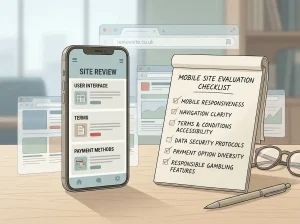
A deposit threshold is only an entry point; promotion eligibility, payment routes and other account terms need separate checks.
Low-Deposit Casinos: What a £1 Minimum Actually Means
A stated £1 minimum deposit describes the lowest amount an operator says it will accept for a deposit. It is a threshold, not a description of the casino as a whole. It does not establish which games are available, whether a promotion can be claimed, or what conditions apply to any offer. Those are separate terms and need to be assessed separately.
The same distinction applies to a £10 minimum. The figure tells only what the operator presents as the entry point for depositing; it does not, by itself, show that the amount is enough to qualify for a particular promotion. Nor does a low advertised minimum establish that the account is suitable for every player or that the operator is legally entitled to serve customers in Great Britain. A number on a promotional page is not a licence.
The word “minimum” also needs to be read in context. It may refer to the lowest deposit the operator accepts, rather than a recommended amount or a required balance to keep in the account. The relevant terms should make clear what the figure applies to and whether it is tied to a particular funding route or offer. Without those details, the amount alone cannot settle what a transaction will do.
Check the operator before funding the account
In Great Britain, commercial gambling is regulated by the UK Gambling Commission. Remote operators serving customers in Great Britain must hold the relevant Commission licence even when their key equipment is located elsewhere. A casino’s location, branding or description as “new” does not replace that requirement.
The Commission grants operating licences to businesses and personal licences to individuals working in regulated roles. For a player considering an online casino, the business’s operating status is the central check: a legal online casino serving customers in the UK must hold a current operating licence. The Commission is the sole regulator for commercial gambling in Great Britain, so a claim of oversight by a different body does not stand in for the required UK licence.
Before depositing, the operator’s licence number should be checked against the UK Gambling Commission’s public register. The number should match the business providing the gambling service, rather than merely appear somewhere on a page. Licensed operators must also display licence information on their gambling websites or apps and link to the public register entry. A functioning link and a matching record make the claim verifiable; a badge or general statement does not do that work.
This check is relevant whether the advertised minimum is £1, £10 or another amount. A low threshold does not reduce the licensing requirement, and a higher one does not demonstrate compliance. The deposit figure and the regulator’s record answer different questions.
What a low threshold does—and does not—tell you
A £1 minimum can make the first transaction smaller, but it does not tell how much play that balance will support. The outcome depends on the games and the amounts staked, neither of which is defined by the minimum deposit itself. The label is therefore a statement about entry to the account, not a forecast of session length or potential returns.
Age checks are another part of the process. Operators must verify a customer’s age before allowing a deposit into a gambling account. A site that invites payment before completing that check is not following the stated UK requirement. New customers must also be prompted to set a financial limit before their first deposit, with account-level controls available for managing limits. These are practical checks at the point of account funding, not features that can be inferred from the advertised minimum.
The licensed environment also includes safeguards beyond the initial transaction. UK-licensed casinos must provide responsible-gambling tools, including self-exclusion. They must offer an internal complaints process and access to an approved Alternative Dispute Resolution service. These protections do not change the amount accepted as a deposit, but they are part of the regulatory framework in which a legal operator should function.
A useful reading of “online casino with a £1 minimum deposit” is therefore narrow: the operator is presenting £1 as its lowest deposit threshold. It says nothing on its own about current availability, promotional eligibility, game conditions or the quality of the service. Those details require separate checks, while the licence, age verification and account controls establish whether the basic conditions for depositing are in place.
Do
- Check the operator’s licence number against the UK Gambling Commission’s public register
- Verify that the operator prompts you to set a financial limit before the first deposit
- Use responsible-gambling tools and internal complaints processes
Don’t
- Assume a low minimum deposit threshold reduces the licensing requirement
- Rely on a general statement or badge instead of a functioning link to the public register
- Treat a promotional minimum as a guarantee of session length or returns
Recommended online casinos
- JetsetspinsBonus: 200% Bonus + 100 Free Spins + Free Royal Wheel · Payout speed: 1-3 business days
- SlotoSportBonus: 500% up to £ 10 200+ 777 FS · Payout speed: 1-3 business days
- WinBeastBonus: €5000 + 500 FS + €650 Freebet · Payout speed: 1-3 business days
- DieselwinBonus: Welcome Pack 250% up to £4000 + 200 FS · Payout speed: 1-3 business days
- ChanzeBonus: Slots Welcome Bonus #1 200% up to €500 · Payout speed: 1-3 business days
- NightWinBonus: £900 + 400 free spins · Payout speed: 1-3 business days
- ZombillionBonus: Welcome Pack 250% up to £4000 + 200 FS · Payout speed: 1-3 business days
- AmunbetBonus: Join now and get 450% up to 2,700 GBP + 450 FS · Payout speed: 1-3 business days
Depositing £1, £5, £10 or £15: Bonus Thresholds Change the Calculation
A casino’s minimum account deposit and a bonus’s qualifying deposit are separate conditions. The first determines how little can be transferred into an account; the second determines whether that transfer activates a promotion. A site may therefore accept a £1 or £5 deposit without treating either amount as sufficient for its First Deposit Bonus.
The distinction matters across the full range of amounts. If an offer requires a £10 qualifying deposit, depositing £1 or £5 falls short, while £10 reaches the stated threshold. A £15 deposit also clears that threshold, but it does not make a different offer available if that offer requires more. The amount accepted by the cashier is not a substitute for the promotion’s own terms.
A specialist review reports that casino bonus qualifying deposits can be set at £10, £20 or £50. It also characterises £10 as the minimum required for most UK casino bonuses. Those figures describe the review’s account of offers, not a rule that applies to every operator or promotion. The live offer terms determine the actual threshold.
That makes the £1, £5, £10 and £15 comparison conditional rather than a ranking of casinos. Against a £10 threshold, £1 and £5 do not qualify; £10 and £15 do. Against a £20 threshold, none of those deposits is enough. A £50 threshold is higher still. The calculation is simply the amount deposited compared with the qualifying amount stated for that offer.
Online Casino with 500% Bonus: How It Works
For a casino with a £1 minimum deposit in the UK, the low account floor may be useful for depositing real money, but it does not establish that a bonus can be claimed with £1. The same applies to a £5 minimum deposit: the account may accept that amount while the promotion requires a larger qualifying deposit. Conversely, a £10 or £15 account deposit should not be assumed to activate an offer unless its terms set a threshold no higher than the deposit made.
The wording of the offer matters. “Minimum deposit” can refer to the amount needed to fund the account, while “qualifying deposit” identifies the amount that counts toward a promotion. Where the terms specify a qualifying amount, that is the relevant comparison. If the offer also sets conditions on which payment or deposit counts, the stated sum alone may not settle eligibility.
A useful comparison therefore records two amounts for each option: the account’s deposit floor and the offer’s qualifying deposit. If the second is higher than the first, the lower account minimum does not unlock the bonus. If it is equal to or below the planned deposit, the amount condition may be met, subject to the offer’s other eligibility terms. This avoids treating a small advertised minimum as evidence of a small bonus threshold.
The practical result is that £10 is a dividing point only for offers that set their qualifying deposit there. A £15 deposit can clear that threshold, but it cannot convert an offer requiring £20 or £50 into an eligible one. The cashier amount and the promotion amount belong in separate columns; combining them is how a low minimum becomes a misleading headline.
Bonus Thresholds
A casino may accept a £1 or £5 deposit for account funding, but these amounts may not be sufficient to activate a First Deposit Bonus if the qualifying threshold is higher, such as £10.
A £15 Minimum Deposit: The Amount That Leaves the Account
A casino showing a £15 minimum deposit sets a threshold for adding money to an account. It does not mean that £15 is a fee, a bonus, or a guaranteed starting balance after promotional terms. The payment is a transfer from the chosen funding source; once accepted, the amount is available as account funds under the operator’s rules.
That distinction matters for budgeting. The £15 is money committed to gambling, not a discount on the cost of play. Any amount still in the account remains subject to the site’s withdrawal rules, identity checks and payment procedures. The displayed minimum alone says nothing about how quickly a withdrawal is processed or whether a particular payment route is accepted. Those details belong to the operator’s current terms, not to the deposit threshold.
A minimum can also be confused with a suggested amount. If the account allows a £15 payment, that establishes only that the deposit meets the stated floor. It does not establish that £15 is the smallest amount accepted by every payment method, or that the same threshold applies to every promotion. The amount presented at the cashier should be checked against the account terms before confirming the transaction.
Treat the deposit as its own line item
A useful cash-flow view separates the deposit from anything the casino may add later:
| Account movement | What it means |
|---|---|
| £15 deposit | Money transferred from the selected funding source |
| Promotional credit | A separate amount governed by its offer terms |
| Winnings | Funds generated through play and subject to applicable rules |
| Withdrawal | Money requested from the account, subject to the operator’s process |
The table is a distinction, not a promise that an offer or withdrawal will be available. A bonus does not turn the original deposit into a free payment. If promotional funds are involved, their eligibility and conditions must be considered separately from the cash deposited.
Bonus wagering requirements specify how much play is needed against the bonus amount before that bonus can be withdrawn. That condition concerns promotional funds; it does not change what left the bank or wallet when the deposit was made. Combining the two figures into one apparent balance can obscure the amount that is actually the player’s own deposited cash.
For a £15 minimum deposit casino in the UK, the relevant cash question is therefore direct: can that amount be set aside for gambling without affecting money needed elsewhere? A deposit may be small in comparison with other household spending, but it is still an expenditure once transferred. Treating the threshold as an affordable recommendation would confuse the operator’s acceptance rule with a personal budget decision.
Check the account before money moves
In Great Britain, operators offering remote gambling to customers must hold the relevant UK Gambling Commission licence, regardless of where their key equipment is located. Online gambling is legal for adults aged 18 and over at properly licensed sites. The operator must verify age before allowing a customer to deposit, so a deposit should not be treated as a way to test whether an account can be opened.
The licence can be checked on the Commission’s public register before funding the account. A licensed casino’s website or app must also show its licence details and link to the public register information. This is a more meaningful check than relying on a familiar-looking brand name or a payment page.
Licensing Risk
Remote operators serving customers in Great Britain must hold a current UK Gambling Commission operating licence; claims of oversight by different bodies do not replace this requirement.
New customers must be prompted to set a financial limit before their first deposit, and account-level limit controls must remain accessible. That makes the £15 threshold only one part of the decision: the account limit should reflect the amount that can be spent, rather than being adjusted simply to accommodate a casino’s minimum.
A UK-licensed casino must provide responsible-gambling tools, including self-exclusion. It must also offer an internal complaints process and access to an approved Alternative Dispute Resolution service. These protections do not make a deposit recoverable on demand; they define safeguards and routes for handling problems under the regulated system.
The practical reading of a £15 minimum is narrow but useful: at least that amount is required for the stated deposit action. It does not establish the value of any offer, the likely return from play, or the ease of taking money back out. Those are separate terms, and the deposit itself remains the first cash movement to account for.
The £15 Calculation in Pounds, Not Promotional Percentages
A Deposit Match Bonus turns a qualifying deposit into a separate bonus amount according to a stated percentage. The percentage is not the amount credited: it is the rate used to calculate that amount. For a GBP 15 deposit, the calculation is:
GBP 15 × match percentage = bonus before any cap
A specialist review describes deposit-match rates ranging from 50% to 200%. Applied to GBP 15, those rates produce a bonus between GBP 7.50 and GBP 30, before any cap or other offer condition is applied. These are arithmetic outcomes, not a promise that a casino will offer those rates or accept GBP 15 as a qualifying deposit.
Online Casinos with 300% Bonuses: How They Work
At 50%, the calculation is GBP 15 × 0.5, giving GBP 7.50 in bonus funds. At 100%, the match is equal to the deposit, producing GBP 15. At 200%, the bonus is twice the deposit, or GBP 30. The starting cash deposit remains GBP 15 in each case. The bonus changes; the amount transferred out of the account does not.
The rate alone does not establish the final bonus. A Deposit Match Bonus may also have a maximum award. A specialist review describes an example of a 100% match capped at GBP 100. Under those stated terms, a GBP 15 qualifying deposit produces a GBP 15 bonus: the percentage sets the result, and the cap does not reduce it. The cap matters when the percentage calculation would otherwise exceed the stated maximum. Once the calculated bonus reaches that ceiling, depositing more does not increase the bonus.
That distinction is easy to miss in promotional copy. “100% match” describes the rate, while “up to GBP 100” describes the maximum bonus. Neither phrase, by itself, confirms that a GBP 15 deposit qualifies. The offer’s qualifying deposit condition determines whether the calculation applies at all. If the required deposit is higher, the account may still accept GBP 15 while the bonus remains unavailable.
For a GBP 15 minimum-deposit casino, the useful figure is therefore not the headline percentage in isolation. It is the bonus actually generated by GBP 15 under the stated rate and cap, provided the deposit meets the offer’s qualifying condition. A higher rate can produce a larger calculated bonus, but a cap can limit the amount; a low account minimum can also sit below the bonus threshold. Those are separate terms, even when they appear together in one offer.
Bonus Calculation
Identify Rate and Deposit
Take the match rate (e.g., 100%) and multiply it by the GBP 15 deposit to get the potential bonus (GBP 15).
Compare with Cap
Check the result against the maximum bonus cap (e.g., GBP 100); since GBP 15 is below the cap, the calculated amount stands.
Verify Eligibility
Confirm that GBP 15 satisfies the specific qualifying-deposit condition of the offer to ensure the bonus is payable.
The calculation can be checked before any promotional value is assigned: identify the match rate, multiply it by GBP 15, then compare the result with the cap. If the result is below the cap, the rate determines the bonus. If it is above the cap, the cap determines the bonus instead. If GBP 15 does not satisfy the qualifying-deposit condition, neither result is payable as a bonus. A percentage is only one input; the final amount depends on the full offer wording.
Slots, Wagering Contribution and the Cost of Bonus Play
A slot’s wagering contribution determines how much of a qualifying stake counts towards clearing bonus funds. Slots are commonly assigned a 100% contribution, so a qualifying amount wagered on them counts in full. Table games, video poker and live games may count at a lower rate, from 0% to 20%. At a zero contribution, play on that game does not advance the wagering requirement.
The game category therefore affects the amount of play needed to meet a bonus condition. A lower contribution means more of the game’s stake is excluded from the calculation. The stated wagering requirement alone does not show the full cost: the contribution rules determine how quickly eligible play accumulates, while the bonus terms determine what must be completed before withdrawal.
A casino’s minimum deposit and a slot’s contribution rate are separate terms. A £15 minimum deposit describes the entry amount set for an account or offer; it does not establish how a particular slot contributes to wagering. Nor does a low minimum deposit make every game equally useful for clearing bonus funds. The relevant contribution is the one stated in the promotion’s terms for the selected game.
Online Casino with a 400% Bonus: What to Check
Bonus play can also carry a maximum stake condition. A specialist review describes limits linked to the deposit, including a percentage of it, or set as a fixed amount such as £5. That is not a universal rule for every casino: the applicable limit needs to be read in the offer conditions. Exceeding a stated maximum bet can affect bonus eligibility, so the stake restriction belongs in the calculation alongside contribution.
British online slots have separate play restrictions that apply regardless of whether a deposit is £10 or £15. Autoplay is prohibited, and at least 2.5 seconds must pass from the start of one game cycle before another can begin. The maximum stake in a slot game cycle is £2 for customers aged 18 to 24 and £5 for those aged 25 or over. The £5 cap applies to all adults from 9 April 2025.
Those limits set boundaries on the speed and size of slot play; they do not change a casino’s advertised minimum deposit or the bonus contribution percentage. A deposit threshold is an account or promotion condition, while a game’s wagering contribution controls how much eligible play is credited towards a bonus. Treating those as one figure obscures the actual terms.
For a bonus-funded session, the relevant calculation has three parts: the qualifying deposit, the contribution assigned to the game, and any maximum stake condition. Slot play may count fully, but that does not remove other restrictions or make the bonus withdrawable by itself. The written terms determine which games count, at what rate, and under what stake limit.
Slot Play Restrictions
- Slots commonly provide a 100% wagering contribution, while other games may range from 0% to 20%.
- Maximum stakes on bonus play may be limited to a fixed amount, such as £5, or a percentage of the deposit.
- British slot regulations prohibit autoplay and require a minimum of 2.5 seconds between game cycles.
- Maximum stakes in slot cycles are capped at £2 for ages 18–24 and £5 for those 25 or over.
How to Judge a £15 Casino Offer Without a Best-of List
A £15 offer is not valuable because its headline figure looks large. Its practical value depends on the reward currently available, whether the account qualifies, the qualifying deposit, wagering contribution, expiry and the conditions for withdrawing funds. Each term changes what can ultimately be taken out.
Start with the reward and the wagering requirement. Bonus wagering requirements set how much must be staked against bonus funds before those funds can be withdrawn. In Great Britain, the requirement for bonus funds is capped at ten times the bonus amount from 19 January 2026. That cap is a ceiling, not evidence that an offer is favourable. A specialist review has calculated that a £20 bonus at a ten-times requirement calls for £200 in wagering on the bonus component. The calculation concerns the bonus, not automatically the deposited cash; the offer terms determine how each balance is treated.
Next, check whether £15 is enough to qualify. A casino may accept a deposit at that level while attaching a promotion to a different qualifying-deposit condition. The offer must also be available to the account in question. A reward that cannot be claimed, or that is credited only after a stated condition is met, has no practical value until those conditions are satisfied.
Expiry matters because it sets the period in which the promotion can be used. The terms should state when the reward becomes available and when it ends. A short validity period can make a large advertised amount less useful if the wagering cannot be completed within the permitted time. Withdrawal rules matter just as much: check whether bonus funds, winnings generated from them, or both are subject to restrictions, and what must be completed before a withdrawal is allowed.
Online Casino with 600% Bonus: Terms Explained
Compare offers by recording the same details for each: the reward, qualifying deposit, wagering requirement, eligible games and their wagering contribution, expiry, and withdrawal conditions. The lowest wagering figure alone does not settle the comparison; a restriction on eligible play or a demanding expiry can change the result. Nor does a high headline reward establish a higher final cash value.
For a legitimate UK casino, confirm that the operator holds a current UK Gambling Commission operating licence before depositing, and verify its licence number on the Commission’s public register. The register check establishes the relevant regulatory status; it does not make the promotion generous. “Best” is therefore a terms comparison, not a label that can be inferred from a £15 minimum or a welcome headline.
Real-Money Play: Bonus Limits and Account Eligibility
A £15 deposit into a casino account is real money: it is the player’s balance, not a promotional credit. A First Deposit Bonus, if available and claimed, is a separate amount governed by its own eligibility terms. Making a deposit therefore does not, by itself, establish entitlement to a bonus.
The distinction matters when an account can accept funds but a promotion cannot be claimed. Casinos commonly restrict bonus offers to one per household or IP address. That can affect people who share a home or internet connection: a second person may be treated as having already used the offer, even if they have their own account and deposit their own money. The restriction concerns bonus eligibility, not proof that two people are the same customer.
Attention: Bonus offers are commonly restricted to one per household or IP address, meaning a second person sharing a connection may be ineligible even with a new account.
A separate limit applies at operator level. A player can generally take only one new-player bonus from a particular casino operator. Opening another account with that same operator does not create a fresh entitlement to its introductory promotion. The account may still be a real-money account, but the promotional benefit may not be available.
These rules make “new” a condition to verify, not a description that follows automatically from a new registration. The relevant terms determine whether eligibility is assessed by household, IP address, prior use of an offer, or a combination of those criteria. Where a shared connection is involved, the practical point is to check the operator’s wording before treating a bonus as part of the account value.
Real-money access has its own requirements. Operators must verify a customer’s age before allowing a deposit, and new customers must be prompted to set a financial limit before their first deposit. Those steps relate to account funding and control; they do not make a player eligible for a First Deposit Bonus.
For someone comparing a £15 minimum deposit casino with a real-money casino that accepts a smaller qualifying amount, the useful distinction is between the ability to fund an account and the right to receive promotional funds. A deposit can remain available for real-money play even when a bonus is unavailable, subject to the casino’s account terms. The promotion should not be counted as spendable balance until eligibility and crediting conditions are satisfied.
The clean comparison is therefore two-part: whether the account can be funded at the stated amount, and whether the account holder qualifies for the offer. Household or IP restrictions, along with the one-new-player-bonus rule, can change the second answer without changing the first.
Online casino bonus crab UK: offer terms explained
Mobile Deposits and SMS Payments: Check the Funding Route
A mobile casino describes where the account is accessed, not how a deposit is funded. The same distinction matters for a £15 minimum: an operator’s cashier must show whether that amount can be deposited through a particular route. Mobile access alone does not establish that a casino accepts SMS payments or any specific phone-based method.
The payment route must also comply with British gambling rules. Remote gambling operators cannot accept credit-card payments for gambling, including payments routed through a money service business. A wallet is not an exception if it allows credit-card funds to be used for gambling. The relevant question is therefore not only whether a payment is described as mobile or SMS, but whether its funding source is permitted.
For an SMS charge, the payment description is not enough to determine how the transaction is funded. The cashier’s terms should identify the payment provider, the amount charged and any route-specific conditions. If those details do not make the funding source clear, the method cannot be assessed from its label alone. No particular casino’s support for SMS deposits at a £15 minimum should be assumed without checking its current payment information.
Before depositing, the account holder’s age must be verified. Remote operators must also prompt new customers to set a financial limit before the first deposit and provide accessible controls for account-level limits. These steps are separate from the choice of payment method: a working mobile route does not remove them.
The operator’s status matters as well. Remote gambling businesses serving consumers in Great Britain must hold the relevant UK Gambling Commission licence, irrespective of where their key equipment is located. The licence number can be checked on the Commission’s public register before funds are sent.
Deposit Route Check
- Confirm the operator holds a current UK Gambling Commission licence
- Verify the licence number on the public register
- Check that the funding source is not a credit card or routed through a credit-card-funded wallet
- Ensure the payment route accepts the £15 minimum deposit
- Set a financial limit before completing the first transaction
A practical check is to confirm the displayed minimum, the payment route’s funding source and the operator’s licence in the same review of the cashier. If the route’s terms are unclear, its suitability cannot be established merely because it appears on a mobile screen.
No-Deposit Bonuses and Free Spins: Read the Conditions Separately
A no-deposit bonus does not require a qualifying deposit to activate, while a free-spins promotion may be attached to a deposit condition. The label alone does not establish which applies. A casino can advertise free spins but make them conditional on a qualifying deposit, so the activation trigger matters more than the promotional name.
For an offer requiring a deposit, a GBP 15 minimum is a condition of that promotion, not proof that the casino has a general GBP 15 account minimum. The offer terms should state whether the deposit must reach that amount, which payment methods qualify and when the deposit must be made. If the promotion is genuinely no-deposit, a deposit requirement would contradict the label; any separate action needed to claim it should be distinguished from funding the account.
Timing can decide eligibility. Where the terms set a registration window, the qualifying deposit must be made within 48 hours of registration. A qualifying sports bet has a separate deadline: it must be placed within seven days of registration. These are different conditions, and meeting one does not satisfy the other.
Free spins and free bets also settle differently. A free-bet stake is not included in the winnings, so the resulting return is not simply the stake plus the full displayed winnings. The terms determine what happens to the stake and how winnings are credited. For casino free spins, check which games are eligible, when the spins must be used and whether any resulting balance is subject to conditions before withdrawal.
The practical comparison is between the action required and the amount that can ultimately be retained. A no-deposit label does not by itself mean cash is immediately withdrawable, and a GBP 15 deposit does not automatically qualify for every promotion. Registration timing, the qualifying action and the treatment of promotional returns are separate entries in the calculation. A promotion is only as usable as its least flexible condition.
Online Casinos with Daily Promotions in the UK
PayPal and a £15 Deposit: The Wallet’s Funding Source Matters
A PayPal option in a casino cashier does not, by itself, establish that a £15 deposit is accepted. Payment availability and the qualifying deposit amount are separate conditions: the cashier and the offer terms need to state both. The relevant terms can differ between casinos, so no operator or minimum can be inferred from the payment method alone.
The funding source matters because UK-licensed gambling operators cannot accept credit-card payments for gambling. That restriction also applies when a credit card is used to fund a money service business and the funds are then routed to gambling. A wallet cannot be used for gambling payments where it allows credit-card funds to be spent on gambling. Routing a payment through PayPal does not remove that restriction.
A balance held in a wallet and a payment funded by a credit card are therefore not interchangeable for this purpose. Before depositing, the payment route and the wallet’s funding source need to be considered together. The casino’s payment terms should also make clear whether the selected route is accepted and whether it meets any stated qualifying deposit condition. A payment option shown in an account is not proof that every funding source is permitted.
For a UK-facing casino, the operator must hold the relevant UK Gambling Commission licence. The licence number can be checked on the Commission’s public register before an account is funded. Operators must verify age before permitting a deposit, and new customers must be prompted to set a financial limit before their first deposit.
The practical check is narrow: confirm the operator’s licence, then read its current cashier and promotion terms for the PayPal route, funding source and qualifying deposit. If those terms do not confirm that £15 is accepted, the wallet’s presence in the cashier is not enough to establish it.
Published by the Dreams Casino UK Guide team.